Context
Tuberculosis (TB) is a respiratory disease caused by Mycobacterium tuberculosis (Mtb) bacteria. It is one of the main causes of death from an infectious disease worldwide and remains a major public health problem in Madagascar and Cameroon.
There are two main forms of TB:
- Tuberculosis infection (TBI) (formerly known as latent tuberculosis) is an asymptomatic or silent form of the disease. It is estimated that a quarter of the world’s population is infected. People with TBI are not contagious. TB preventive therapy (TBPT) may be offered to people with TBI.
- TB disease is the active, typically symptomatic and contagious form developing in 5 to 10% of persons with TBI. This is referred to as a progression from TBI to TB disease. A person with TB disease can infect between one and ten people they come into contact with, who will then become new cases of TBI. TB disease is curable through long-term antibiotic treatment (four to nine months), defined according to the antibiotic resistance profile of Mycobacterium tuberculosis.
To achieve the major objectives of the END TB strategy to eradicate TB by 2035, the World Health Organization (WHO) advocates the prevention, screening/diagnosis and treatment of both forms of tuberculosis: TBI and TB disease.
While finding and treating those with TB disease remains a priority for national programs for dealing with TB, finding and treating those with TBI presents a number of considerable obstacles in terms of organization, social and cultural issues, technology and logistics. The WHO guidelines for dealing with TBI recommend preventive treatment for all household contacts of a case of TB disease, and especially those who are aged under five or living with HIV (PLHIV). According to this strategy, only a minority of persons at risk of TB can benefit from this prevention measure.
The objective of the APRECIT-BIS project is to help national programs for dealing with TB to improve screening for TBI in populations at risk and to identify the people who may benefit from TBPT. To achieve this, three innovative TBI tests will be transferred and evaluated in Madagascar and Cameroon.
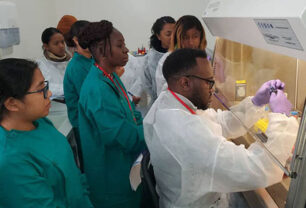
Funded by the ANRS-MIE (Emerging Infectious Diseases) agency, APRECIT-BIS includes a component to strengthen TB research capacity, led by a group of scientists from the Institut Pasteur in Madagascar, the Pasteur Center in Cameroon, the South African Tuberculosis Vaccine Initiative (University of Cape Town, South Africa), Hospices Civils de Lyon and the Mérieux Foundation.
Si identifier et traiter les personnes atteintes d’une TB maladie reste à ce jour la priorité des programmes nationaux de lutte contre la TB, identifier et traiter ceux atteints d’une ITB présente de nombreux obstacles organisationnels, socio-culturels, technologiques et logistiques. Sur le volet de l’ITB, l’OMS préconise un traitement préventif pour tous les contacts intradomiciliaires d’un cas de tuberculose maladie, en particulier ceux âgés de moins de 5 ans et les personnes vivant avec le VIH (PVVIH). Selon cette stratégie, seule une minorité de personnes à risque peuvent bénéficier de cette mesure de prévention.
L’objectif du projet APRECIT-BIS est de soutenir les PNLT (Programme National de Lutte contre la Tuberculose) à améliorer le dépistage de l’ITB chez les populations à risque, l’identification des personnes bénéficiaires du TPT. Pour cela, 3 tests innovants de l’ITB seront transférés et évalués à Madagascar et au Cameroun.
Financé par l’ANRS-MIE, APRECIT-BIS inclut un volet de renforcement des capacités en recherche sur la TB, animé par un groupe des scientifiques de l’Institut Pasteur de Madagascar, du Centre Pasteur du Cameroun, de la South-African Tuberculosis VaccineInitiative (Université de Cape Town, Afrique du Sud), des Hospices Civils de Lyon et de la Fondation Mérieux.