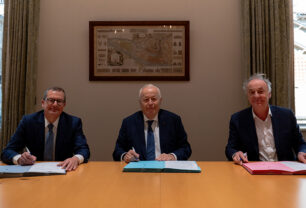
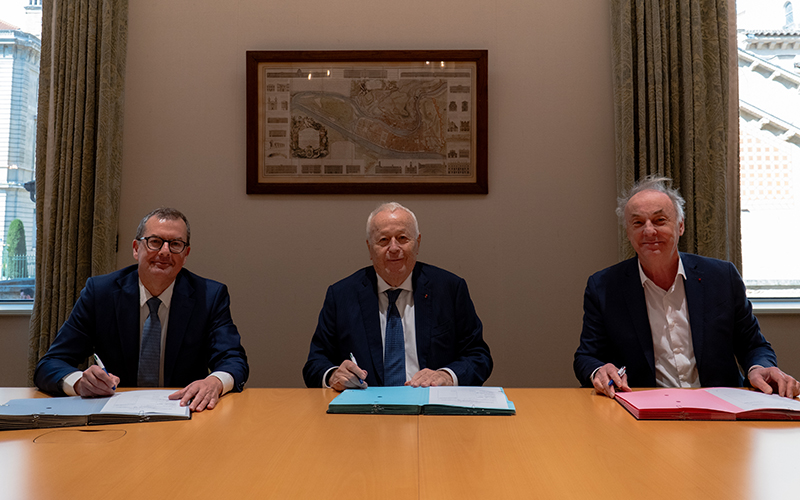
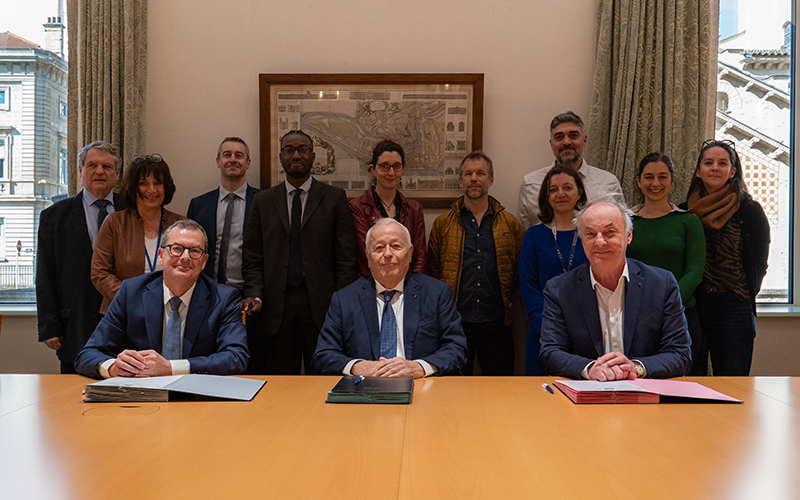
This new framework agreement, signed for a period of five years, sets out the principles and terms of a strengthened partnership between the three institutions. It provides for:
- Training health workers in countries where the Mérieux Foundation operates or at Hospices Civils de Lyon
- Expertise, audit, and support missions carried out by hospital and university hospital professionals from HCL
- The development of joint scientific collaborations, particularly in the context of national and international calls for projects
- The joint development of medical and biological reference systems, teaching modules, and educational tools tailored to local needs
- The joint mobilization of technical platforms and academic expertise for high-impact public health projects
This agreement marks the start of a major mission in Armenia, aimed at strengthening national capacities for the prevention, control, and management of antimicrobial-resistant perinatal infections.
A concrete mission in Armenia: diagnosis, training, and mentoring
Since March 2025, the Mérieux Foundation—whose priority areas include maternal and child health—has been working with HCL to launch a pilot project in Armenia aimed at improving the prevention, control, and management of antimicrobial-resistant perinatal infections, with a view to improving the health of mothers and newborns. The mission focuses on two diseases:
- Screening pregnant women for Group B Streptococcus, the leading cause of neonatal mortality in developing countries.
- The management of urinary tract infections, which are often misdiagnosed and mistreated.
In this context, two HCL healthcare professionals, Dr. Ani Horikian, biologist, and Dr. Claire Triffault-Fillit, an infectious disease specialist in the Infectious and Tropical Diseases Department at Croix-Rousse Hospital, have been mobilized to support diagnostic, training, and mentoring activities with teams of microbiologists at the National Center for Disease Control (NCDC) laboratory in Yeghegnadzor, the pilot laboratory selected for the mission.
Two complementary approaches for comprehensive action
1-Bacteriological diagnosis: structuring practices and modernizing tools
The first part of the project focuses on the NCDC laboratory in Yeghegnadzor, where HCL teams are working to:
- Evaluate and improve analytical techniques: identify needs in terms of reagents, equipment, and diagnostic methods for urinary tract infections and group B Streptococcus infections.
- Develop standardized operating procedures (SOPs): these protocols will ensure the quality and reproducibility of diagnoses, based on international best practices.
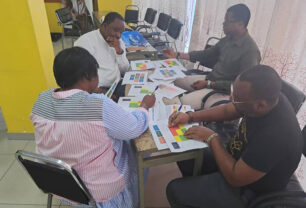
- Training local microbiologists: an on-site mission, carried out between December 8 and 12, 2025, was dedicated to practical training for teams, followed by remote technical support and a consolidation mission in March 2026.
“Screening for Group B Streptococcus in pregnant women has been mandatory in Armenia since January, 2025. However, no positive samples have been recorded in the past year. During our visit, we analyzed the entire diagnostic chain to identify any malfunctions and formalized protocols with the teams in place,” explains Dr. Claire Triffault-Fillit. We also had to convince prescribers that the chain was now working and that they should resume prescribing tests for their patients. After our intervention, the number of samples doubled and positive results increased, which was a great victory!”
2- Strengthening clinical capacities: training and supporting healthcare professionals
The second part of the project aims to strengthen the skills of clinicians, epidemiologists, and microbiologists in the management of perinatal infections and the rational use of antibiotics. To this end, the HCL and Mérieux Foundation teams are implementing:
- Targeted training sessions on interpreting test results and adapting antibiotic treatments.
- Remote mentoring, enabling personalized monitoring of clinical practices and rapid response to emerging needs.
A mission is planned for April 2026, which will strengthen clinicians’ infectious disease skills and provide a progress report on the appropriate prescription of antibiotics based on test results.
“Our goal is to make the Yeghegnadzor laboratory autonomous and efficient, so that it can play a key role in the early detection and management of infections. This is a true partnership with the teams, where mutual exchanges and local political commitment make all the difference,” concludes Dr. Claire Triffault-Fillit, who more broadly defines this partnership with the Mérieux Foundation as a great opportunity for young infectious disease specialists to broaden their vision of medicine.
“The renewal of this partnership with the Mérieux Foundation and Claude Bernard Lyon 1 University is fully in line with a global health approach, which encourages us to think together about human, scientific, environmental, and societal issues. In the face of contemporary health challenges—antimicrobial resistance, the emergence of new diseases, inequalities in access to care—international cooperation and knowledge sharing are key levers.
For the Hospices Civils de Lyon, this framework agreement reflects a clear ambition: to contribute, from Lyon with the decisive support of two partner institutions, to the structuring of more resilient health systems capable of anticipating health crises, disseminating innovation, and sustainably strengthening skills where the needs are greatest. Raymond Le Moign, Director General of the Hospices Civils de Lyon
“The signing of this agreement will strengthen the Foundation’s international activities in the fight against infectious diseases, building on its roots in Lyon and its long-standing and privileged partnership with the Hospices Civils de Lyon and the University of Lyon 1 Claude Bernard.” Alain Mérieux, President of the Mérieux Foundation
“Through this renewed partnership with the HCL and the Mérieux Foundation, Claude Bernard Lyon 1 University reaffirms its commitment to open, useful science that is resolutely focused on major global health issues.
By mobilizing our strengths in training, research, and educational innovation, we are helping to train professionals capable of working in complex health contexts, while co-producing scientific knowledge that is directly applicable in the field. This collaboration fully illustrates the role of a committed university: building bridges between academic knowledge, hospital practices, and the needs of populations. The mission in Armenia is a concrete example of this ambition. It allows our faculty and students to get involved in high-impact projects.” Prof. Bruno LINA, President of Claude Bernard Lyon 1 University