Conducted in partnership with the Pasteur Institute of Madagascar (IPM), the Pasteur Center of Cameroon (CPC), IPBS/CNRS, and CIRI, and funded by ANRS-MIE, the project is promoted by the Mérieux Foundation, providing scientific, methodological, and organizational support for the project, in collaboration with national stakeholders in the fight against tuberculosis.
Launch in Madagascar
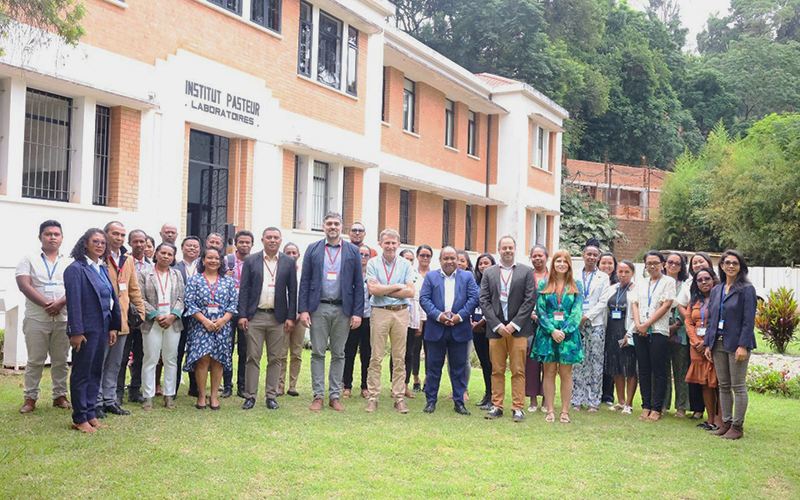
The Pasteur Institute of Madagascar (IPM) hosted the LAM4RO project’s official launch day event on January 15, 2026. The event was attended by representatives of the main institutional, scientific, and operational stakeholders involved in the project, including the Coordinator of the Malagasy Ministry of Public Health’s National Tuberculosis Control Program (PNLT), teams from IPM, as well as national and international partners.
In his opening speech, Professor Tiaray Harison Michel, Coordinator of the PNLT, stressed the importance of improving early diagnosis in the fight against tuberculosis in Madagascar, highlighting that many cases still escape screening and treatment. He explained that the expected results of the LAM4RO project will help to strengthen the national response to the disease, in line with the End TB 2035 goal.
In Madagascar, 84 people with confirmed tuberculosis will be recruited for the study, along with their close contacts. Study-related activities will take place in both clinical and community settings, working closely with partner healthcare facilities.
Launch in Cameroon
In Cameroon, the LAM4RO project was officially launched on February 5, 2026, by the Pasteur Center of Cameroon (CPC). Activities will be conducted at Jamot Hospital in Yaoundé, at the Efoulan District Hospital, and in the community at the homes of patients and contacts in the Djoungolo and Efoulan districts.
At the launch event at the Pasteur Center of Cameroon, project leaders recalled that LAM4RO is part of the World Health Organization’s End TB strategy. By promoting earlier, decentralized diagnosis, the project aims to improve case detection and strengthen the fight against tuberculosis transmission in a context marked by significant under-diagnosis.
The country faces a number of challenges: approximately 46,000 new cases of tuberculosis are estimated to develop each year, nearly half of which go unreported, and the country’s incidence rate lies between 174 and 194 cases per 100,000 inhabitants.
The LAM4RO project
The LAM4RO project aims to evaluate the performance of rapid, non-invasive respiratory and saliva tests based on the detection of LipoArabinoMananne (LAM), a specific biomarker of the bacterium responsible for tuberculosis. These innovative tools will be studied alongside the usual diagnostic methods, with the aim of responding more effectively to the realities on the ground.
Study goals include:
- Triage of pulmonary tuberculosis cases,
- Treatment efficacy monitoring
- Identification of paucibacillary or subclinical forms in intra-domestic contacts of index cases,
- Cost-benefit analysis of the new tools.
The Mérieux Foundation is the research project’s promoter, providing scientific, methodological, and organizational support for the project, working closely with national anti-tuberculosis actors. Through this commitment, the Foundation is contributing to the development of diagnostic innovations suitable for contexts with limited resources, and to the sustainable strengthening of health systems.
Tuberculosis remains one of the leading causes of infectious mortality worldwide, with nearly 10 million new cases each year. Despite the progress achieved, under-diagnosis remains a major challenge, particularly among children and in contexts with limited resources. As an alternative to analyzing sputum, which is often difficult to obtain and logistically challenging, the LAM4RO project explores diagnostic approaches based on the detection of LAM in exhaled breath condensate and saliva. These methods could pave the way for earlier and more decentralized screening.