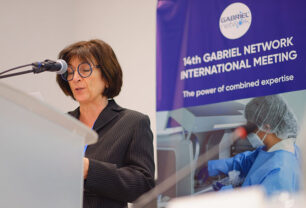
“In a constantly evolving world, we must adopt a strategy similar to that of bacteria themselves: one that continuously adapts, evolves, and responds to changing environments.” The event kicked off with powerful statements from Alain Mérieux, President of the Mérieux Foundation, emphasizing the need for a Pasteurian vision of health, meaning global, borderless, and based on collaboration between countries, disciplines, cultures and sectors.
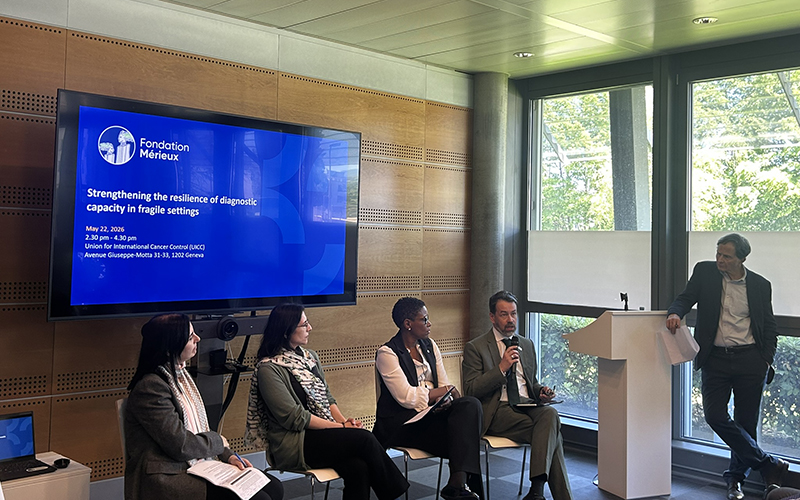
During the two-session conference, marked by insightful interactivity between the audience and the panelists, participants delivered a converging message. Resilient diagnostic systems are no longer a technical luxury, but a central pillar of health security, equitable access to care, and crisis preparedness.
The event’s moderator, Prof. David Heymann from the London School of Hygiene & Tropical Medicine, notably reminded the broader challenge facing the global health community. While diagnostics are essential for outbreak detection, patient management, surveillance, and vaccination strategies, they remain underprioritized and particularly vulnerable in fragile settings. He stressed that discussions on resilience must move beyond emergency response and address the long-term structural conditions required to build reliable and equitable laboratory systems.
Lessons learned from experience
Experiences from Haiti, Lebanon, Syria, and the Democratic Republic of the Congo clearly showed that fragile settings share similar structural challenges, despite very different contexts.
In a pre-recorded video, Prof. Jean-William Pape, from GHESKIO in Haiti, illustrated how his institution manages to maintain healthcare and laboratory services despite increasing violence, repeated natural disasters, political instability and major staff displacement. GHESKIO’s contingency plan, developed over 30 years ago and continuously updated after every crisis, relies on redundancy systems, permanent coordination and security committees, fuel reserves, decentralized service delivery, strong logistics, and fully electronic medical records accessible across sites.
His intervention highlighted how resilience is the result of preparation and, as other panelists would later confirm, that preparedness begins long before crises emerge.
“Resilience depends on continuously adapting systems to evolving realities, learning from each crisis, and building operational flexibility at every level of the institution,” he concluded.
Building on this, Mikael Garnier-Lavalle, from the Pandemic Fund, shared the Fund’s objective to support sustainable preparedness efforts rather than isolated emergency projects. He stressed the importance of domestic country investment and ownership, particularly for supply chains and workforce development, describing the Fund’s catalytic approach as a “proof of concept” model requiring national commitment alongside international financing.
Dr Rhonda Sealey-Thomas, from PAHO, emphasized the importance of sustained development in laboratory networks, health workers, interoperable systems, and regional cooperation to ensure continuity of services during crises. She underlined how public-private partnerships and regional connectivity can reinforce resilience during crises.
In Syria, Dr Aula Abbara described how years of conflict, sanctions, fragmentation, and destruction devastated the country’s laboratory system, with nearly 90% of microbiology laboratories destroyed. Yet she also highlighted new partnership dynamics emerging after the fall of the Assad regime, with increased collaboration between actors inside and outside the country, international universities, technical partners, and the Syrian diaspora.
From Lebanon, Dr. Nadeen Hilal described a context where attacks on primary healthcare centers and severe financial pressures forced authorities to prioritize continuity of essential services over broader system reforms. Lebanon responded by decentralizing laboratory strategies, integrating diagnostics into primary healthcare, and leveraging digital systems such as DHIS2. Human resources nevertheless remain a major challenge, with only around 30% of the required workforce capacity currently available and a major brain drain affecting the country. Discussions also highlighted the growing and complex importance of diaspora engagement.
Several recurring priorities emerged from the first session’s discussions: stronger contingency planning, reduced fragmentation between actors, sustainable financing models, stronger primary healthcare systems, and approaches that view emergencies as opportunities to strengthen systems rather than create parallel structures. Workforce resilience appeared as one of the most consistent concerns, alongside the need to improve living and working conditions in order to reduce brain drain and encourage return of diaspora from abroad.
Global challenges and shifts in the international context
The event’s second session shifted toward broader global discussions, aiming to identify the political, financial and operational conditions needed to strengthen the resilience of diagnostic capacity, while integrating considerations of equity, fair care, and sustainability
Philomena Raftery, from the World Health Organization (WHO), commented that laboratory systems and diagnostics have historically been neglected and underfunded despite being foundational to both health security and essential health services. She noted that while the COVID-19 pandemic contributed to greater recognition and attracted major investments in laboratories and diagnostics, many countries are now facing declining funding, putting sustainability at risk. She stressed the need to adopt a Systems Approach and a sustainability mindset supporting countries to build, optimize, and sustain integrated national laboratory systems, especially in the current global funding and geopolitical climate. She stressed that sustainable financing must be grounded in strong national laboratory governance and strategies, with donors supporting nationally defined priorities. She noted that emergencies should not only trigger short-term response activities but should be used as opportunities to enhance sustainable national systems. In response to WHA Resolution 76.5, WHO is developing an Essential Package of Diagnostics for Humanitarian and Public Health Emergencies to help countries define priority needs and streamline procurement during crises. Philomena also cautioned that while innovative technologies offer tremendous opportunities, they also risk deepening existing inequities and that the “best” technology is not always the most advanced one — it is the most appropriate one for the context.
Ed Newman, from GOARN, highlighted the importance of trusted international partnerships and mobile laboratory support during outbreaks, including the current Ebola response in the Democratic Republic of the Congo. He emphasized that mobile laboratories should reinforce existing national systems rather than operate independently. “The idea is to plug into and strengthen national laboratory systems, not to take over,” he explained. He also noted that many countries remain hesitant to formally request international support during crises.
From Médecins Sans Frontières, Dr. Catherine Villegas called for a “reality check” between preparedness discussions and realities on the ground. She argued that despite years of global discussions, conditions in many fragile settings have not fundamentally improved. Rather than treating diagnostics as products to be delivered during emergencies, she stressed the need to see them as long-term services that require sustained investments, local adaptation, and operational innovation.
She also highlighted that innovation should be developed with those who will actually use it in the field, like frontline users, national laboratories, national authorities. In fragile settings, the real innovation is whether a diagnostic tool works in real conditions, can be used by the staff, can be maintained and sustained.
The discussions also underscored the growing interconnection between diagnostics, surveillance, and vaccine preparedness. Urrutxi Gallastegi, from CEPI positioned diagnostic resilience as an essential component of future pandemic preparedness by highlighting the importance of diagnostics for identifying circulating strains, targeting appropriate vaccines, and conducting effective clinical trials.
By the end of the event, a clear consensus had emerged that diagnostic resilience depends on long-term investments in local capacities, governance, workforce development, logistics, digital systems, regional cooperation, and trust.